



“Lubricity improver” products are added to diesel or gasoline to enhance their lubricating properties. Diesel and gasoline fuels contain components that can have a cleaning effect and help prevent wear on internal combustion engine parts, especially in modern high-pressure engines and fuel injection systems. When these fuels undergo hydrotreating processes at the refinery, these natural lubricating components are lost.
The addition of a lubricity improver helps reduce wear and friction in the engine, protecting its parts and extending engine life. Moreover, a fuel with good lubricity can also improve engine efficiency by reducing fuel consumption and pollutant emissions.
It is also important to note that, in some countries, regulations require diesel and gasoline fuels to meet certain lubricity specifications to protect vehicle engines. Therefore, fuel manufacturers may use lubricity improvers to meet these specifications and ensure quality fuel for consumers.
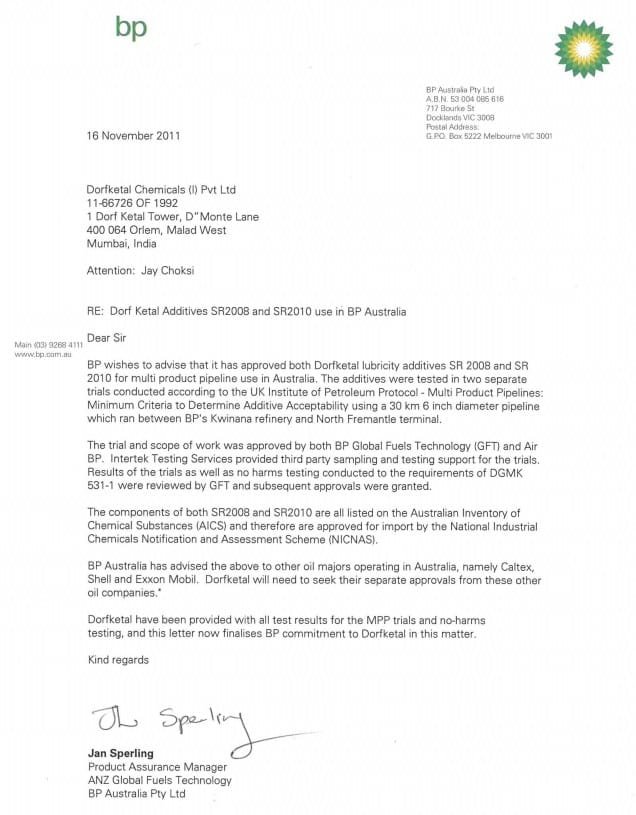
However, fuel transportation is generally carried out through pipeline networks, which also include aviation kerosene (Jet A1). A lubricity improver product can only be applied to gasoline or diesel in a pipeline that also transports Jet A1 if it is approved by competent regulatory authorities. This is the case addressed in this technical note, where BP issued a letter of approval for the use of DORF SR2008 and DORF SR2010 products.
Below is a non-certified Portuguese translation of the letter originally issued in English.
RE: Dorf Ketal Additives SR2008 and SR2010 used in BP Australia
Dear Sir,
BP wishes to inform that it has approved Dorf Ketal’s lubricity improver additives, named SR2008 and SR2010, for use in multi-product pipelines in Australia.
The additives were tested in two separate experiments conducted in accordance with the United Kingdom Petroleum Institute Protocol – Multi-Product Pipelines: Minimum Criteria for Determining Additive Acceptability, using a 30 km, 6-inch-diameter pipeline between BP’s Kwinana Refinery and the North Fremantle terminal.
The test and scope of work were approved by BP Global Fuels Technology (GFT) and Air BP. Intertek Testing Services provided third-party samples and testing support for the experiments. The test and non-damaging trial results conducted under DGMK 531-1 requirements were reviewed by GFT, and subsequent approvals were granted.
All components of SR2008 and SR2010 are listed in the Australian Inventory of Chemical Substances (AICS) and are therefore approved for import under the National Industrial Chemicals Notification and Assessment Scheme (NICNAS).
BP Australia has advised the above to other major oil companies operating in Australia, namely Caltex, Shell, and ExxonMobil. Dorf Ketal will need to seek separate approval from these other oil companies.
Dorf Ketal has received all MPP and non-damaging test results, and this letter now concludes BP’s engagement with Dorf Ketal on this matter.
Sincerely,
Jan Sperling
Product Assurance Manager | ANZ Global Fuels Technology BP Australia Pty Ltd