


INTRODUCTION
A Major Latin American Liquid Cracker was facing several problems in the Light End Unit related to fouling control, including the very short run-length in its reboilers. The Plant has a Front-End design, with High and Low-Pressure Depropanizers, and a capacity of 450 KTA of Ethylene.
Fouling problems were occurring despite the system being treated by a competing company. Given this fact, the Plant was considering installing a second spare reboiler, since the depropanizers shared the same spare reboiler. Thus, DORF KETAL was challenged to improve fouling control while increasing operational efficiency and reboiler life.
UNDERSTANDING THE MECHANISMS BEHIND THE CHALLENGE
In the Light End design, the compound most likely to polymerize is the 1,3-butadiene, due to its significant reactivity. It is known for having a high tendency to react through different exothermic paths, in which the most representative is the free radical mechanism.
The primary mechanism of the 1,3-butadiene polymerization on the Light End area is the Free Radical Mechanism. It has three steps: Initiation, Propagation, and Termination.
The initiation step is characterized by generating free radical molecules through thermolytic fission. High process temperatures initiate this free radical formation and can be catalyzed by the presence of metallic ions. The formed radicals, called initiators, can react in two different ways, depending on the existence or non-existence of oxygen.
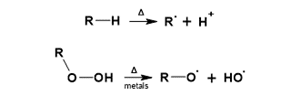
The second step of polymerization – the propagation – is characterized by forming a polymeric structure of a low cross-link ratio that isolates the free radical so that it can grow without being terminated. This process can happen in two different ways: if there is oxygen in the system, the radicals will quickly react, forming peroxide radicals, which, under high temperatures, will allow the free radicals to propagate and create longer chains. In the absence of oxygen in the system, the initiator will react with a monomer, forming a longer radical. This process will keep happening at a constant rate of Kp.
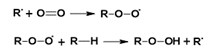
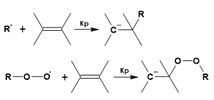
The final step of the polymerization process is the termination, in which the reacting center is destroyed. Two distinct agents can originate from this destruction. It can be caused by either an inhibitor, which reacts with the initiator or the peroxide, transforming them into non-radical species, or by the own polymeric propagation chain.
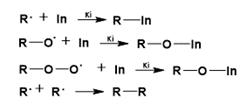
In the presence of peroxides or any other free radical initiators, the butadiene will start its polymerization. In the Ethylene Units, the peroxides usually originate from the carboxylic acids. Moreover, if there is any contact with air, its oxygen will help with the free radical formation, which will then start the polymerization.
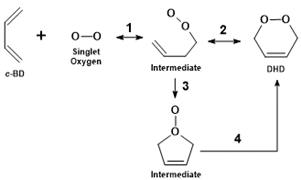
A secondary polymerization mechanism seen in the Light End Unit is the Diels-Alder Condensation, which is the mechanism behind the dimerization of 1,3-butadiene. Dimerization is a bimolecular homogeneous reaction, non-catalyzed by oxygen and inert to antioxidants. Another characteristic of the dimerization is the fact that it has the same kinetics in both liquid and gas phases. The dimerization reactions are thermally initiated, and their reaction rate increases approximately ninefold for each 20 °C increase in temperature.
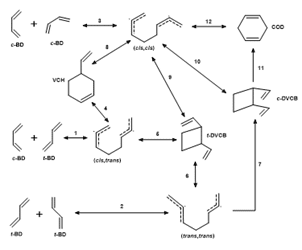
Other than the 1,3-butadiene, several different compounds, such as isoprene, 1,2-butadiene, cyclopentadiene, and other unsaturated dienes, are present in the Light End streams and can polymerize too. The Dienes can cause considerable prejudice to the system since these molecules exhibit cross-linking polymerization. The cross-linking polymers are highly insoluble and adhere to the internals of the equipment, making the cleaning process between runs a challenge.
CONTEXTUALIZING THE SYSTEM
The Light End Unit of this Front-End Cracker was designed with a High-Pressure Depropanizer (HP DeC3), whose bottom goes to a Low-Pressure Depropanizer (LP DeC3). Both columns have a reboiler and share a spare reboiler, as designed by the licensor.
The occurrence of fouling has always been a problem for the Depropanizers, even when under competitor chemical treatment. The average run-length of the reboilers was around five months, and this short campaign was creating challenges to the cleaning and maintenance services, since the high amount of cross-linking polymers was reducing the efficiency of the cleaning activities. As a result, the Plant was evaluating the construction of a second spare reboiler so that each Depropanizer would have additional equipment.
PROPOSED TREATMENT
Before the customer’s CAPEX expense, DORF KETAL has implemented a highly technological product, supported by a robust monitoring program (including both process and analytical tools). The selected product to control polymerization was POLYGUARD™ DA 2301, a blend of free radical inhibitors and antioxidants. With this blend, the chemical product could terminate the polymer chains before they grew excessively, while also reducing the effects of peroxide radicals.
To assess the system performance with POLYGUARD™ DA 2301 treatment and avoid any sudden fouling occurrence, some efficiency variables were observed and monitored. Amongst them, it is possible to highlight the reboiler fouling factor and gum content. Based on this information, DORF KETAL was able to properly optimize the chemical treatment, seeking improvements in the performance and reliability of the system.
RESULTS AND BENEFITS OF THE TREATMENT
With the POLYGUARD™ DA 2301 treatment, DORF KETAL was able to gradually increase the reboilers’ run-length, going from nearly 150 days as average for the previous competitor’s treatment to almost two years of the campaign.
As shown in Figures 1 and 2, both the reboilers consistently increased performance, setting a new baseline for these equipment operations. The improvement achieved was more than enough for the Plant to cancel the plans to install a new spare reboiler, avoiding a vital CAPEX expense.
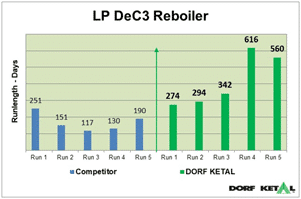
The improvement in the reboiler’s performance is one of the best indicators for the Light End Units since this equipment faces the highest temperature and acts as a filter for the polymers formed in the system. As the reboilers’ running length increases, it means that polymerization is under control in all the arrangements, including the distillation towers.
In summary, DORF KETAL‘s Light End treatment was a huge success, establishing new baselines for the reboiler’s operation, reducing fouling formation, and guaranteeing the complete run of the High and Low-Pressure Depropanizers for a total of six years.
In addition, it allowed the customer to save around $450,000 by avoiding the purchase of a new spare reboiler.